Why Do Kenyan Sand Boas Need a Heat Lamp, Not a Heat Mat? The First-60-Days Mistake Beginners Make
Kenyan sand boas need an overhead halogen heat bulb rather than the under-tank heat mat that works for most other beginner snakes: both of the species-specific care sheets that actually cover Eryx colubrinus list overhead halogen as the heat source and neither lists a heat mat. But the device is only half the answer, and the half most setup advice gets wrong. The published veterinary cases do not blame heat mats as a category — they blame direct, unregulated access to a heat source, which means a bulb hung where a snake can reach it is not automatically safe either.
What follows takes the six things new keepers most often believe about heating this species in its first 60 days and checks each one against the care sheets and against clinical reports of reptile burns. The measurable targets are collected in a table near the end.
Key takeaways
- Care sheets from ReptiFiles and Dubia.com both recommend overhead halogen heat bulbs for this species and neither lists a heat mat; Dubia.com also advises against ceramic heat emitters.
- Basking surface target: 93–95°F measured at the sand; cool zone roughly 72–83°F depending on the source; heat off at night.
- The documented hazard is unregulated contact heat: a published royal python case involved a non-thermostatically controlled mat that malfunctioned and left second- and third-degree burns across two-thirds of the ventrum.
- Substrate must be loose and deep enough to burrow in — a minimum of 3–4 inches, with some sheets recommending up to 6. Juveniles eat every 1–2 weeks, adults every 2–4 weeks.
Figures checked: November 5, 2026.
Belief 1: "The mat is the dangerous part, so a bulb is the safe part"
Half right, and the wrong half is the dangerous one. Unusual Pet Vets, an Australian exotics practice, describes burns "caused by direct access to heat sources" as "some of the most common causes of illness in reptiles," and names heat rocks and mats specifically because they "often malfunction and overheat." The same handout applies the identical logic to bulbs: "if heat lamps are utilized, they should be out of reach, with a mesh covering preventing the reptiles from curling around the bulb."
The clinical case that makes this concrete is a royal python written up in Vet Times by Sonya Miles in April 2019. The owners were using "an non-thermostatically controlled heat mat to create a temperature gradient inside the snake's vivarium"; the mat malfunctioned, friends noticed smoke coming from the enclosure, and the snake presented with "an extensive second and third-degree burn covering two-thirds of the snake's ventrum." Treatment ran four weeks before it could be stopped. Note what the case report actually indicts: not the existence of a mat, but a mat with no thermostat between it and the animal.
For a first-60-days setup that means two line items most beginners skip entirely. A thermostat or dimmer on whatever heat source you choose, and a fixture the snake physically cannot reach. The device choice below matters, but it sits on top of those two.
Belief 2: "If it gets too hot, the snake will just move"
This is the assumption that makes contact heat feel safe, and it is the one the veterinary literature contradicts most directly. Unusual Pet Vets puts it plainly: "There are many theories as to why reptiles do not have the same heat response as to humans and why they do not remove themselves from the heat before getting burned. Some of these theories include reptiles having different heat and pain receptors as well as reptiles not associating the pain sensation with the objects they are touching."
So the problem is not only that a burrowed sand boa has limited room to retreat downward. It is that the withdrawal reflex a keeper is implicitly relying on may not fire at all. Add the species' behaviour — it spends the overwhelming majority of its time pushed down into several inches of sand, frequently with only eyes and nostrils exposed — and contact heat is being applied to an animal that is both pressed against it and unlikely to object in time.
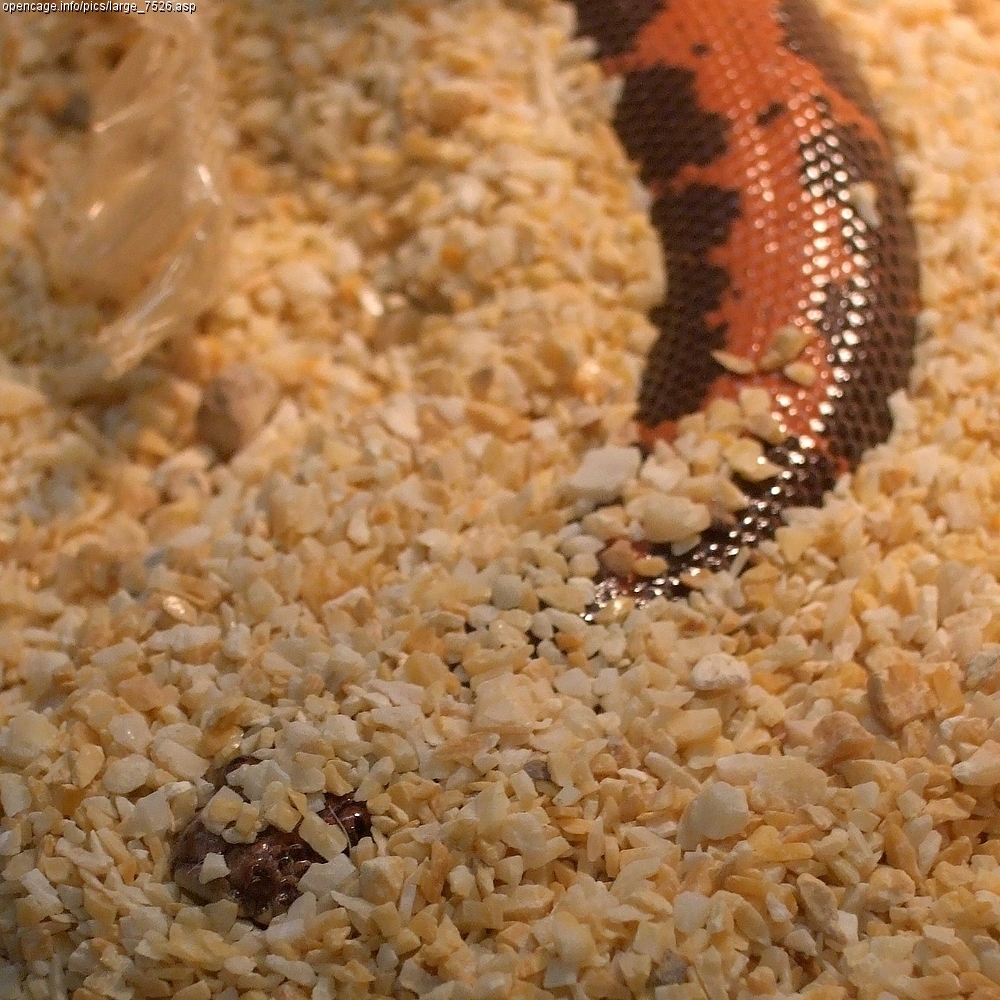
Why this species in particular: Eryx colubrinus (Linnaeus, 1758) is recorded by The Reptile Database across Egypt, Sudan, South Sudan, Ethiopia, Eritrea, Kenya, Tanzania and Somalia, and the loveridgei form in the photograph above is listed from "arid areas of Kenya and NE Tanzania." Dry, loose ground is where it lives, and burrowing is not an optional behaviour you can design around.
Belief 3: "A ceramic heat emitter is the safe compromise"
Here the sources genuinely disagree, and it is worth seeing the disagreement rather than being handed one answer. Dubia.com's sheet for this species explicitly advises against ceramic heat emitters along with heat mats, on the reasoning that radiant emitters suit species basking in open air rather than sand-dwelling burrowers. The Vet Times case, by contrast, ends with the clinician recommending exactly that for the burned python: "a thermostatically controlled ceramic heat emitter instead of a heat mat," with the emitter "surrounded by a cage to prevent the snake from coiling around it."
Both statements can hold, because they answer different questions. The vet was replacing a contact heat source for a snake that had already been burned, and reached for a controlled, guarded, non-contact option. The care sheet is choosing an optimal heat source for a burrowing desert species, where overhead halogen also delivers the surface-level basking temperature this animal needs. Where the two agree is the part worth copying: controlled, guarded, non-contact. If you own a ceramic emitter already, that agreement is your floor; the halogen recommendation is the species-specific optimum on top of it.
Belief 4: "Three inches of sand is deep enough"
Three inches is the bottom of the acceptable range, not a target. ReptiFiles lists a minimum of 3–4 inches; Dubia.com's sheet goes up to 6. Suitable material is a sandblasting-grade sand, a commercial reptile sand, or a mix of roughly 60% additive-free topsoil to 40% play sand.
The failure shows up in days 1–14, and it is easy to misread. A boa that cannot fully submerge tends to stay visibly stressed and may refuse food well past the point acclimation alone would explain — which a new keeper usually interprets as a sick snake rather than a shallow enclosure. Depth is also a maintenance variable: waste should be spot-cleaned daily and the full layer refreshed every few months, because sand holding moisture and waste together is a larger health risk for an animal evolved for consistently dry ground than for a rainforest species.
Belief 5: "It refused its first meal, so something is wrong"
Usually it means the opposite — that the snake is doing what a newly moved animal does. Leave it alone for the first several days and offer the first meal only after an undisturbed stretch in the new enclosure. A sand boa that will not eat in week one is generally still acclimating rather than ill, provided the temperatures are correct, which is why the basking reading has to be confirmed at the sand surface before the animal goes in rather than after a problem appears.
Feeding then settles into a rhythm: juveniles take prey roughly as wide as the snake's thickest point about every 1–2 weeks, adults every 2–4 weeks, with prey sized at roughly the snake's widest point or about 10% of body weight. By days 31–60 the snake should be using both the warm and cool ends rather than staying buried in one spot — that behaviour, not the thermometer alone, is the sign the gradient is actually working.
Belief 6: "It's a docile species, so early handling is fine"
Temperament and timing are separate questions. The species is commonly recommended to beginners for its small adult size and generally docile nature, but the two handling mistakes in days 15–30 are picking the snake up too soon after a meal and reaching in from directly above, which reads to the animal like a predator strike and invites a defensive bite. Waiting 24–48 hours after feeding, and lifting from the side rather than overhead, avoids most of it. Kenyan sand boas regularly live 15–20+ years in captivity, so there is no handling milestone worth rushing in month one.
The numbers your thermometer should read
| Target | ReptiFiles care sheet | Dubia.com care sheet | How to verify it |
|---|---|---|---|
| Basking surface | 93–95°F | near 95°F | Infrared thermometer aimed at the sand, not the air above it |
| Cool zone | 78–83°F | 72–80°F | Same instrument, opposite end, before the snake goes in |
| Night heat | off | off | Timer on the fixture, not a nightly memory task |
| Substrate depth | 3–4 in minimum | up to 6 in | Ruler, at setup and after each full substrate change |
| Bulb starting point | around 75 W for an average adult enclosure, then adjusted to hit the surface target | Adjust by measured temperature, never by wattage alone | |
| Feeding interval | juveniles 1–2 weeks, adults 2–4 weeks | Prey about as wide as the snake's thickest point | |
Two costs come with doing it this way, and neither is hidden. A halogen bulb draws more power and dumps more heat into the room than a small mat, and it needs a timer to go dark at night, which is one more component than a set-and-forget mat. A guard or mesh adds another. That is the price both care sheets and both veterinary sources accept for a heat source the animal cannot press itself against for hours, and against a four-week burn treatment it is not a close call. If a heat mat is already in the drawer from a previous snake, the useful move is to keep it for a species that basks on top of substrate and budget for the halogen fixture, thermostat and guard this one's own care sheets point to.
Tip: Getting the overhead gradient right is mostly a measurement problem, so a digital terrarium thermometer hygrometer at substrate level tells you far more than guessing by touch. Pair it with some reptile habitat decor so your boa has cover to surface under during those first weeks. (These are Amazon Associate links — we may earn a small commission on qualifying purchases.)
FAQ
Can you use a heat mat for a Kenyan sand boa?
The care sheets specific to this species do not list heat mats as a heat source and generally advise against them, and an exotics practice notes that mats and heat rocks "often malfunction and overheat." A published clinical case involved a non-thermostatically controlled mat that malfunctioned and burned two-thirds of a snake's underside. Overhead halogen is the standard recommendation for this species instead.
Is an overhead heat lamp automatically safe?
No. The same veterinary guidance that warns about mats says heat lamps "should be out of reach, with a mesh covering preventing the reptiles from curling around the bulb." A bulb plus a thermostat plus a guard is the safe arrangement; a bare bulb the animal can reach is a different burn risk, not the absence of one.
How deep does the substrate need to be for a Kenyan sand boa?
At least 3–4 inches per ReptiFiles' care sheet, with some sheets such as Dubia.com's recommending up to 6 inches. Deeper substrate supports natural burrowing; shallow substrate is associated with visible stress and food refusal.
What temperature does the enclosure need?
A basking surface of roughly 93–95°F measured at the sand, with a cooler zone in the low-to-mid 70s to low 80s Fahrenheit, and heat turned off overnight. Measure at the surface the snake actually contacts rather than the air above it.
Is a Kenyan sand boa a good first snake?
It is commonly recommended for its small adult size and generally docile temperament, but its heating and substrate needs differ enough from more commonly kept beginner snakes that following generic "beginner snake" setup advice, rather than this species' own care sheets, is the main way new keepers get the setup wrong.
Related reading
- The Rosy Boa Overfeeding Mistake: Why a Weekly Feeding Schedule Is Too Much in the First 60 Days
- The Twice-Daily Misting Mistake: Why Green Anoles Dehydrate in the First 60 Days
- California Kingsnake Care for Beginners: Setup, Temps & Feeding
Tip: Getting the overhead gradient right is mostly a measurement problem, so a digital terrarium thermometer hygrometer at substrate level tells you far more than guessing by touch. Pair it with some reptile habitat decor so your boa has cover to surface under during those first weeks. (These are Amazon Associate links — we may earn a small commission on qualifying purchases.)
Correction November 5, 2026: An earlier version of this article attributed the burn risk to the heat mat as a device and explained it by the snake having "nowhere to retreat." Veterinary sources describe the cause as direct access to an unregulated heat source — the published royal python case involved a non-thermostatically controlled mat that malfunctioned — and note that reptiles may fail to withdraw from contact heat for sensory reasons rather than only positional ones. The article now states that a thermostat and a guarded fixture matter alongside the choice of device, that an unguarded bulb carries its own burn risk, and that the care sheet and the clinical case disagree about ceramic heat emitters. Sources: Vet Times (Miles, April 2019); Unusual Pet Vets, Thermal Burns in Reptiles.
Sources
- Kenyan Sand Boa Care Sheet — ReptiFiles (species care sheet: temperatures, substrate depth, feeding intervals)
- Kenyan Sand Boa Care Sheet — Dubia.com (species care sheet: heat source recommendations and cautions)
- Sonya Miles, "Ventral thermal burn in a royal python," Vet Times, 1 April 2019 (clinical case: non-thermostatically controlled heat mat, second- and third-degree ventral burns, four-week treatment)
- Unusual Pet Vets, "Thermal Burns in Reptiles" (causes, why reptiles may not withdraw from contact heat, guarding heat lamps)
- The Reptile Database, Eryx colubrinus (Linnaeus, 1758) (taxonomy, subspecies and distribution)
Start Here: every care guide by species · About · Privacy Policy


Comments
Post a Comment